Five Steps to Organizing Your 'Co-creating our city’ project
There are five key steps to the research process using Citizen Science and co-creation. Each step plays an important role in ensuring meaningful participation and effective results:
- Define a common research goal: Include different perspectives and rely on co-researchers to consider the relevance for the community.
- Determine methodological approach: Consider what suits the research question and take into account the co-researchers' ideas, access, and lived experience.
- Collect data: Train and involve co-researchers in data collection.
- Analyze data: Train and involve co-researchers in the analysis of data.
- Disseminate and use findings: Distill key recommendations and choose accessible forms of presentation and communication that suit your target audiences.
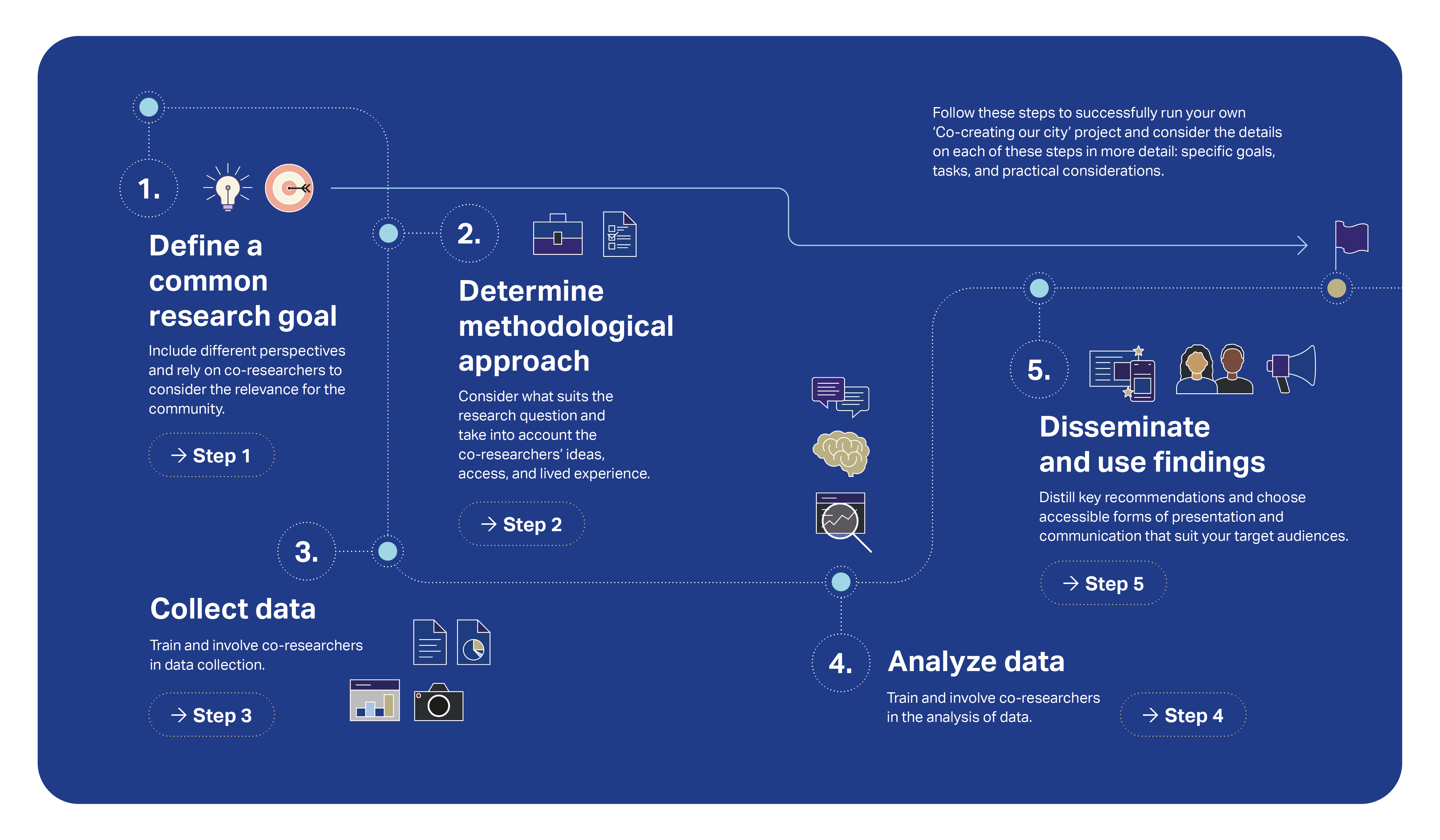
Follow these steps to successfully run your own 'Co-Creating Our City' project and consider the details on each of these steps in more detail: specific goals, tasks, and practical considerations.
Step 1: Define a common research goal
Defining a clear objective is crucial for any research project, and in particular for a 'Co-Creating Our City' project. In the beginning, your project team should focus on identifying what change is needed and why and decide which specific challenges or gaps you want to investigate.
To do so jointly with co-researchers, it is important to gather a variety of ideas on the type of change your community needs and the objectives you want to pursue, for example in a brainstorming session with your co-researchers. This ensures a broad perspective rooted in your community and allows the group to see all potential areas of interest, even those you might not previously have thought of. It is important to try and remain open and flexible during this first step and to be able to adapt to new ideas and feedback from the co-researchers as the project objectives evolve.
Next, identifying commonalities among all potential objectives and areas of interest, for example by grouping aspects that go together, helps with prioritization and allows you to choose a research question and make compromises where necessary.
When settling on a research objective for your project, consider two types of objectives:
- Knowledge objectives (What knowledge is needed to achieve this?). These define what kind of information and understanding you want to achieve.
- Practical objectives (What do you want to do?). These are important for the impact you want your research to achieve.
When phrasing research objectives for your 'Co-Creating Our City' project, it can be a good idea to use the SMART criteria: objectives should be Specific, Measurable, Attainable, Realistic, and Time-bound. Applying SMART criteria to your chosen research objectives ensures clarity, feasibility, and accountability, and helps your project achieve research outcomes that are both meaningful and directly actionable.
Finally, based on your chosen research objectives, you can develop a focused and specific research question. This research question will steer the rest of the research process.
Case study: Research objectives and research question from 'Co-Creating Our City' pilot project in Düsseldorf
This example demonstrates how we worked through research objectives and toward an overarching research question in our pilot project in Düsseldorf.
Knowledge objectives:
- Understand how youth in Düsseldorf feel and what they wish for in terms of their opportunities to engage with political issues and in their communities.
- Understand which barriers youth experience and what hinders productive dialogue between city administration and young people.
Practical objectives:
- Reach all youth in Düsseldorf, especially the ones who are otherwise overlooked, e.g., marginalized young people or those who do not already engage with city institutions or third sector organizations.
- Develop ideas and solutions how barriers to youth engagement in Düsseldorf can be addressed.
Research question:
What has to happen so that ALL young people can engage with political issues in Düsseldorf?
How you can adapt the process to fit your city
Step 1 and the start of your collaboration with co-researchers is also a good moment to:
- introduce data on youth engagement that may already exist in your community,
- introduce relevant city departments and key members of staff,
- discuss what are current issues and debates in your city, and
- share information on basic aspects of city governance.
Sharing this kind of contextual information early, in your first or second workshop, helps all participants to be aware of the local context and aligns research objectives with ongoing governance and policy discussions.
Step 2: Determine methodological approach
The approach you choose for your research project should allow your team of co-researchers to answer the research question and achieve the chosen research objectives. It is important that your methods suit the research question, but also that they are robust and inclusive of your co-researchers' unique knowledge, access, and capabilities.
The first step in deciding your methodological approach is to clarify which data is needed to answer your research question, who can collect this data and when, and how it will be analyzed. Your co-researchers have unique knowledge about and access to their communities that should be taken into account when making decisions about research methods.
To enable effective participation, it may be necessary to train co-researchers in some basic methods of social research, building their confidence and capacity to contribute meaningfully and to help with data collection. This also involves considering what support your co-researchers may need to be able to help with data collection, for example financial resources, time, or extra support. By addressing each of these aspects, the research process becomes more collaborative, empowering, and inclusive of all those involved.
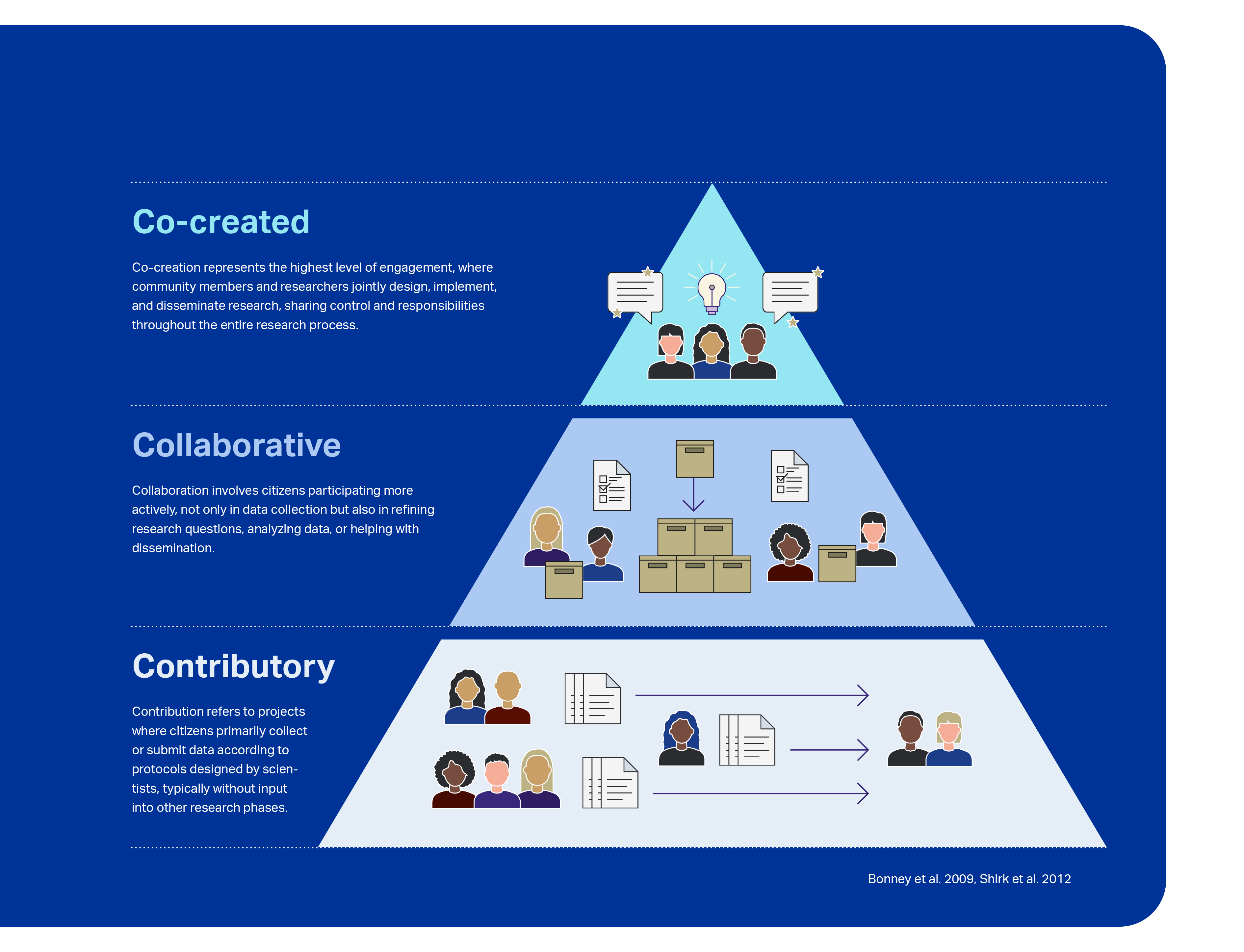
In social science, many projects use mixed methods approaches. This way, different methods can complement each other and solve different parts of the research problem, as in this project where three methods have been combined.
Step 3: Collect data
In participatory research, data collection is conducted collaboratively by researchers and trained Citizen Scientists. This allows researchers to rely on bigger teams of data collectors, provides unique access to the communities that are being researched, and ensures that different perspectives are included in the data.
To enable genuine participation and fit the circumstances and schedules of the co-researchers, the data collection phase should be planned with sufficient time and allow for some flexibility. Particularly in the early stages of data collection, it can be a good idea to work in small teams of researchers and co-researchers, as this builds trust and helps everyone become familiar with the data collection methods. In later stages, division of labor can allow you to collect more and better data, as you rely on your team of co-researchers to conduct observations, interviews, or surveys.
It is essential that every step of the data collection remains transparent and traceable, allowing all participants to follow and understand which decisions were made and why. This approach ensures diverse contributions to the data you collect, builds trust in the validity of the data, and encourages shared ownership of the findings.

Well, I think that the young people are completely amazing. We did 89 surveys of the people of their age and a number of one-on-one interviews and a focus group. They really put themselves out there to figure out what information they actually wanted. And they just volunteered to pick up every aspect of the work and presentation, and talk to adults about this project, which I think is really amazing.
Katarina Moyon
Project Lead, City of Charlotte
Step 4: Analyze data
In participatory research, it is crucial to select data analysis methods that are appropriate to both the research question and the co-researchers involved. Choosing a simpler method of analysis that your co-researchers can contribute to over, for example, a complex method that requires specific expertise enables their meaningful participation in the analysis and interpretation of the data.
By integrating the knowledge and skills of the co-researchers into the analysis process, you can add depth and relevance to the findings. While co-researchers might not bring any experience in analyzing data, they add diverse and contextual forms of knowledge on how to interpret the data in light of what they know about their community to the data analysis.
Recognizing this contextual knowledge as offering valuable and unique insights for the interpretation of your data is key. This is why, as a researcher, you should focus on preparing data for interpretation, coordinating, moderating, and providing guidance to co-researchers during the data analysis. This ensures that the process of analyzing the data remains collaborative and involves the rich and diverse perspectives of the co-researchers.
Step 5: Disseminate and use findings
To use research results effectively and achieve the impact and change you set out to achieve requires careful planning. In this stage, you should go back to your research objectives and consider the kinds of audiences you want to inform and the type of change you want to see based on your data and evidence.
The first step is to identify the specific audiences to whom you want to communicate findings, to ensure that your evidence and recommendations reach those for whom they are most relevant and impactful. Note that you might want to present and discuss your findings with multiple and different audiences, for example young people, a specific community, and policymakers.
Next, it is crucial that you prepare and present the findings appropriately and in an accessible way, tailoring what you select and how you present information to your different audiences. For example, policymakers might appreciate concrete written findings and recommendations, and a brief summary of how the evidence was collected, while the general public might benefit from more creative visualizations of data and findings. Targeting your communication of findings to specific audiences further enhances the reach of your research findings and ensures the results are presented in the most effective way depending on the unique needs of each audience.
Finally, it is important to consider how to acknowledge your co-researchers explicitly and by name, for example through co-authorship or by asking your co-researchers to present findings in meetings, blogs, or the local media. This acknowledges their contributions and promotes fairness and transparency in recognizing who played a role in and made the research possible. Including your co-researchers in the dissemination of research findings also adds their perspectives and experience to the presentation of findings, which can change and sometimes enhance the way others experience and perceive the findings. In this way, the dissemination of results becomes participatory, impactful, and respectful of all contributors.